SEO Tips For Expanding Into German-Speaking Markets
So, you’re ready to expand into the land of wheat beer, sausage, and potatoes?
I’ve got good news for you!
With a large and affluent consumer base, Germany is an attractive market for many businesses.
But there’s one little catch: you need localization.
What’s localization, you ask?
Well, it has a lot to do with adapting your messaging to meet local cultural standards.
And while that first and foremost includes the language, it also covers traditions, humor, market expectations, and more.
Regardless of whether you’re looking to expand into Germany or another country, you must understand your audience’s unique needs and how to reach them before you can successfully market your business to them.
So, before you go and start directly translating your English content strategy into German, you should know that adapting to German SEO is far more than just a translation job.
German consumers have different search habits, preferences, and intent than English speakers.
Simply translating your existing content strategy is only about 10% of a true German market expansion.
To succeed in German-speaking markets with SEO, you must create a German SEO strategy from scratch.
In this article, you’ll learn:
Why A German Market Expansion Is Worthwhile
Even though localization requires additional effort, Germany is one primary market that’s absolutely worth it to invest in. Here’s why:
- The German-speaking DACH region (Germany, Switzerland, and Austria) is a thriving consumer market. Thanks to each country’s large GDP per capita, they enjoy a high standard of living – which means consumers have more money to spend on new products.
- The DACH region has a 93% average internet penetration, which means there are 94 million internet users in the market. In a nutshell: comprehensive internet access + high standard of living = more money for your brand.
- In Germany, 91% of internet users rely on Google for their search needs. This makes SEO in particular a powerful tool for reaching German consumers.
Important note: When expanding your business into the German market, it is essential to work with native speakers to build your SEO strategy, because that’s your direct line for understanding local messaging requirements.
Developing your SEO strategy based on your target market’s needs helps you create quality content that resonates with your audience.
It may even give you a first-mover advantage, especially if your business is in a new and niche industry.
How To Craft A Winning German SEO Strategy In 6 Steps
Learning how to hang with the Germans at Oktoberfest may seem intimidating and challenging at first.
But with a few key steps, you can create a German SEO strategy that can immensely impact pipeline growth in this burgeoning market.
The 6 Steps For Building A Winning SEO Strategy In The German Market |
||
| Localize your business strategy | Prep your site structure | Find your German competitors |
| Do German keyword research | Localize your keyword map | Localize your content |
1. Localize Your Business Strategy
Let me give you a concrete example of a real business that was recently looking for help expanding in the DACH region.
Due to the U.S. and U.K. being their primary markets, international markets come second place in terms of investment but are still required to bring in high levels of new business.
After looking through their website for about 30 seconds, I noticed a major problem:
Although their website is translated to German (emphasis on the translated, not localized), their chatbot was only offered in English.
I tried typing in German in the chatbot. No reply.
It kept trying to force me to book a call with a person in the U.S.
I then wrote, “Does this person speak German?” in the German language, but again no reply.
Now imagine this scenario for the potential German customers of this business.
They’ve come to the website from Germany, read through the website in German, and now, do you think they feel comfortable booking a call with an English-speaking salesperson in the US?
I can most wholeheartedly tell you it’s a big “no.”
That’s why it’s not enough to just translate your existing content into German.
You also need German-speaking salespeople and customer service representatives who can interact with buyers in their language.
It’s crucial to localize your entire business strategy, otherwise, your target audience will continue choosing your competitors who do offer the buying experience they expect.
2. Prep Your Site Structure
Now that we’ve gotten the business stuff out of the way, let’s move on to SEO.
Before creating any content, you first need to check that your website is set up for multiple languages, which is most often done with the URL structure.
There are two options for this:
- Option 1: example.com/de (the subfolder approach).
- Option 2: de.example.com (the subdomain approach).
Whenever you have the option within your CMS (content management system) and technical infrastructure, always opt for the subfolder approach.
This helps transfer DA (domain authority) from your main .com domain to your German website, which means you’ll be able to rank for German keywords faster.
Once your site structure is set up, it’s also crucial to use href lang tags on your pages.
This way, you can assign a page to each market. By doing this, you’re more likely to appear in search results for German users looking for content in their language.
3. Find Your German Competitors
When it comes to competitors, localization is a major factor yet again.
While you may already know which websites you’re competing with in your native market, it’s important to understand that they will likely not be your organic search traffic competitors when you enter the German market.
Let’s say you’re a marketing automation software company that wants to expand into Germany.
SEOquake is a helpful plugin for comparing SERPs (search engine results page) in different languages and countries.
The main keyword you’d want to rank for in English markets might be “marketing automation tool.”
Here’s what SEOquake shows me as the English SERPs for the U.S.:
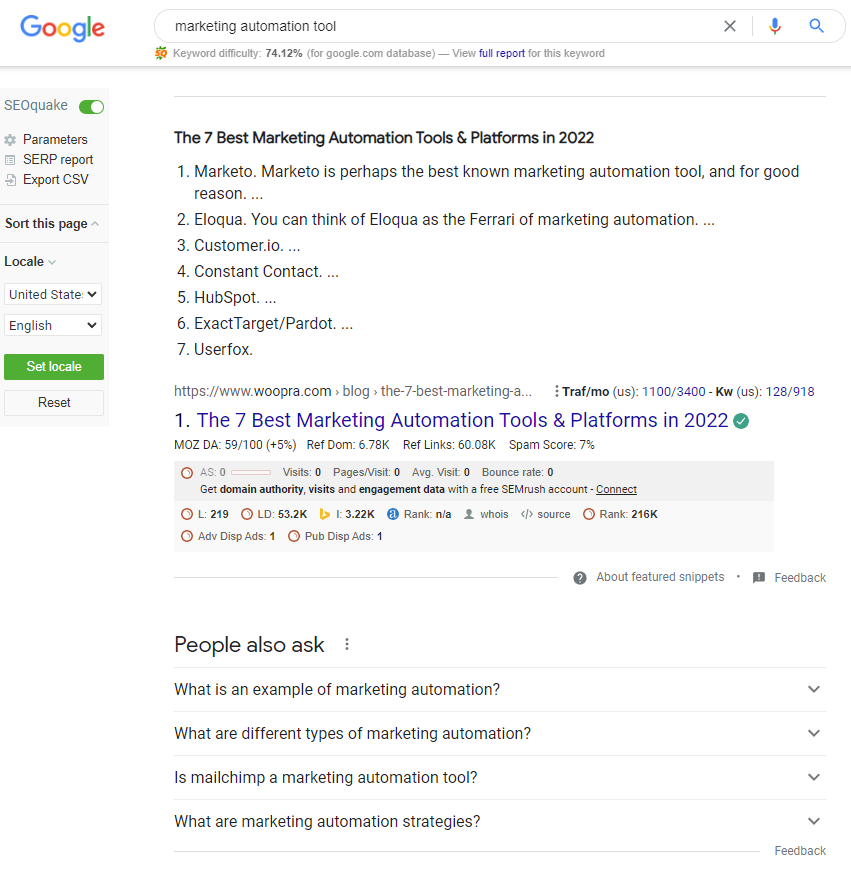 Screenshot from search for [marketing automation tool], Google, June 2022
Now take a look at what I get when I search for [marketing automatisierung tool], the German equivalent for that English term, in Germany:
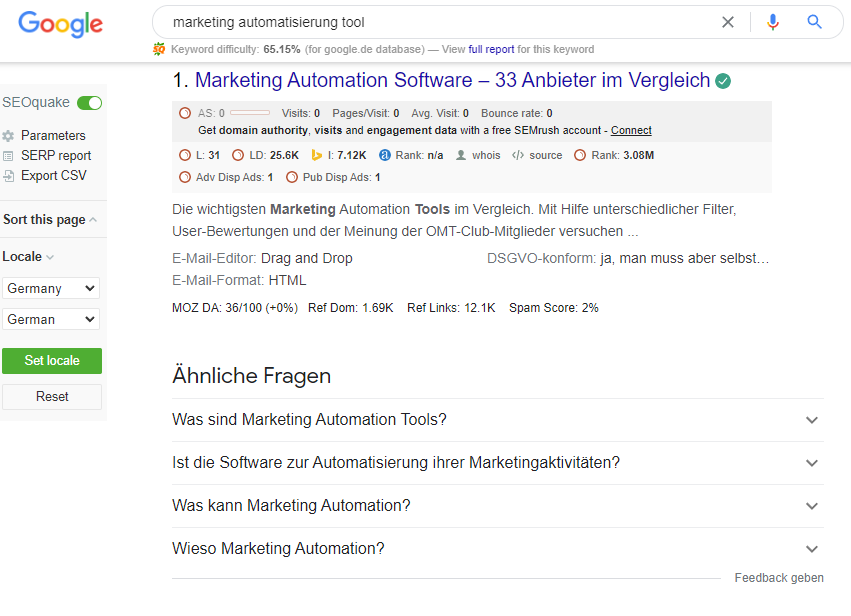 Screenshot from search for [marketing automatisierung tool], Google, June 2022
This difference is precisely where your opportunity for German market expansion lies.
When you localize keywords and your content to compete against local SERPs, you position your SEO strategy to generate leads and sales with localized high purchase intent keywords.
Just rinse and repeat this strategy for your main keywords and you’ll start to see trends about who your top German search competitors are.
But make sure that you follow up with these readers by offering them a buying experience that’s entirely in German.
4. Do German Keyword Research
Once you have a list of your German competitors, it’s time to do keyword research.
Keywords are the heart of your expansion strategy because that’s where you connect content to the high purchase intent keywords I mentioned above.
To help you do your keyword research, try the following steps:
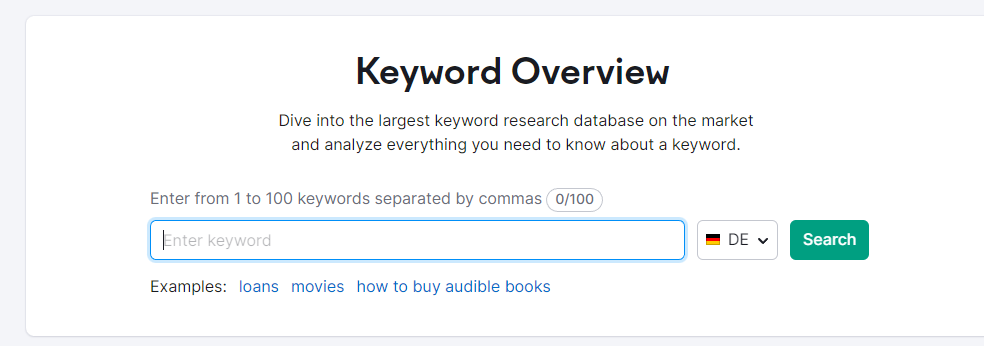
Step 1: Set your keyword research tool (here shown with Semrush) to the German market.
 Screenshot from Semrush, June 2022
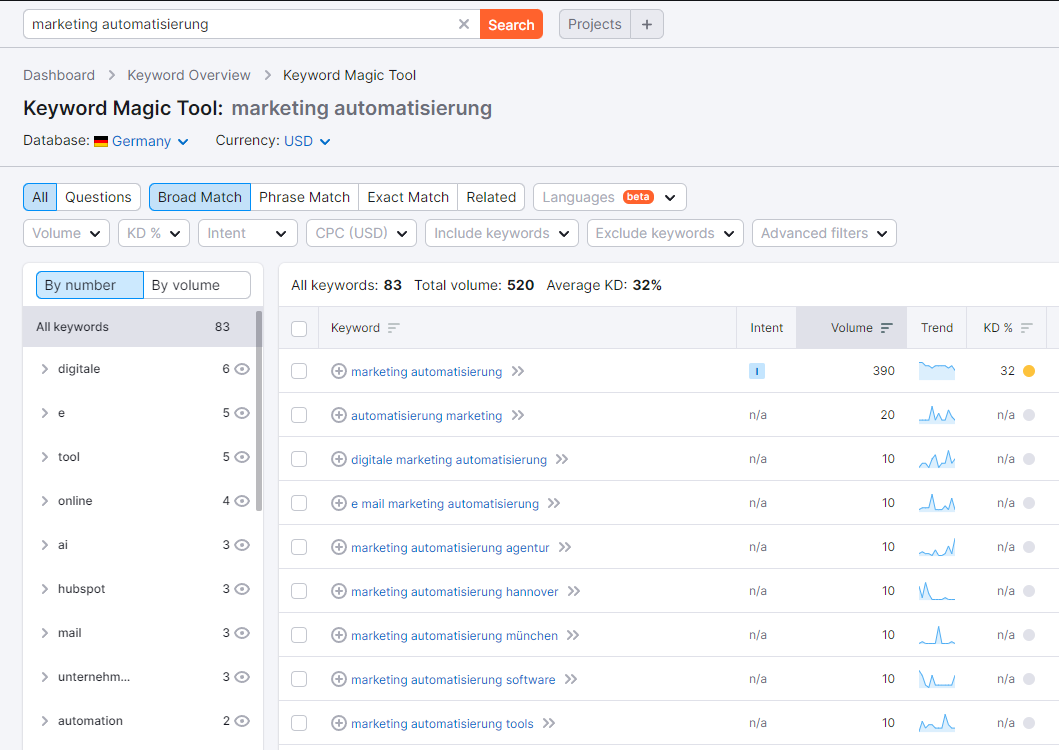
Step 2: Using Semrush’s keyword magic tool, type in a German keyword.
I always recommend starting with a vague head keyword, because then you can view the whole related keyword cluster in a list.
 Screenshot from Semrush, June 2022
Step 3: Then select longtail, search intent match keywords here that have search volume and could potentially fit into your strategy based on the content you’d like to create.
Step 4: The best way to determine where and how certain keywords fit into your content is to check their SERPs by using SEOquake as I showed in the previous section.
One caveat: Semrush can be a bit limited for German SERPs data, so if you’re planning to heavily expand into Germany using SEO, it might be worthwhile to purchase an SEO tool with a more robust German database, such as Sistrix.
The key thing to remember during the keyword localization process is that you shouldn’t just translate keywords from your brand’s first language to German.
While just translating content easily leads to content that’s never even read, the process I described ensures that your content production resources focus on localized keywords that have the opportunity to rank and impact your leads and sales in Germany.
5. Localize Your Keyword Map
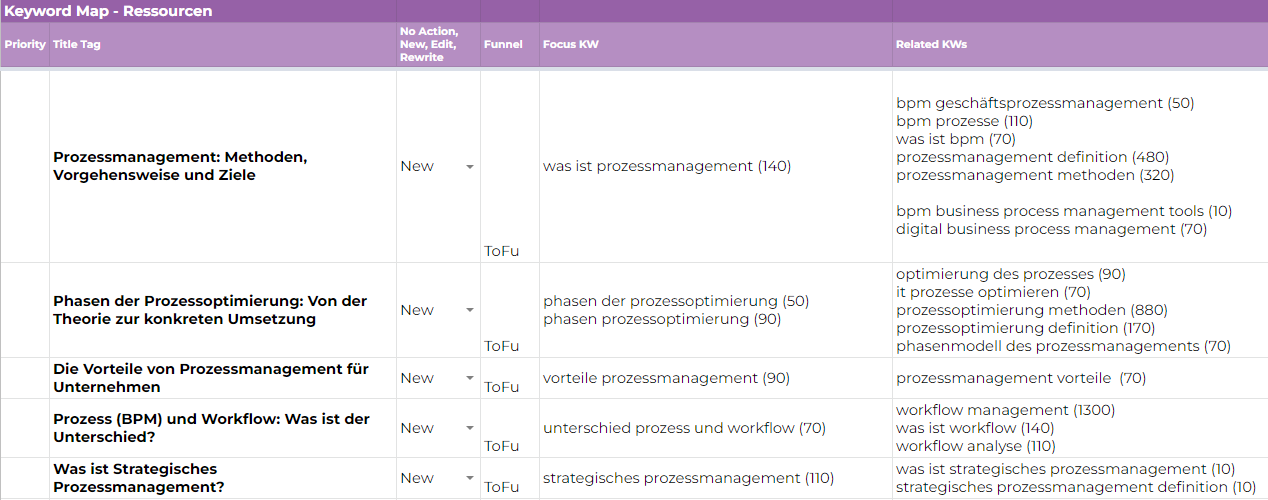
After the initial keyword research is done, it’s time to build your keyword map.
This means crafting German keyword clusters by search intent and ensuring that your German keyword map reflects your target audience’s needs across the sales funnel.
Here’s an example of how my team and I typically lay this out in Google Sheets:
 Screenshot from author, June 2022
Doing this also allows you to determine which content from the original English-language website can be transcreated (translated and localized with specific keywords), and which new pages should be created in German.
Some pages in English won’t even need to be transcreated to German if your keyword research shows it’s not relevant to the German market – which is a primary reason why localization is much more laser-focused than pure translation.
6. Localize Your Content
The final step to developing your German SEO strategy is to localize your content.
For each content piece you plan to develop for your German audience, do the following:
Do your research.
Understand what Germans are searching for online, what kinds of content they engage with, and the messaging style they’re used to. One quick example is that German is often much more formal than U.S. and U.K. English.
Repurpose your top-performing existing content.
If you have existing English content that’s doing well, consider transcreating it into German if the topic is also relevant to the German market.
Make sure to optimize it for local German keywords that have search volume and match search intent to give it the best possible chance of generating leads and sales.
Write new German-specific content.
Creating new and original content is especially important if you’re targeting Germany as a foreign market because there will be elements in Germany that don’t exist in the U.S. and U.K. markets.
When you show the German audience that you understand them by investing in content that’s specifically relevant to them, that’s a significant trust builder that brings them much closer to purchase.
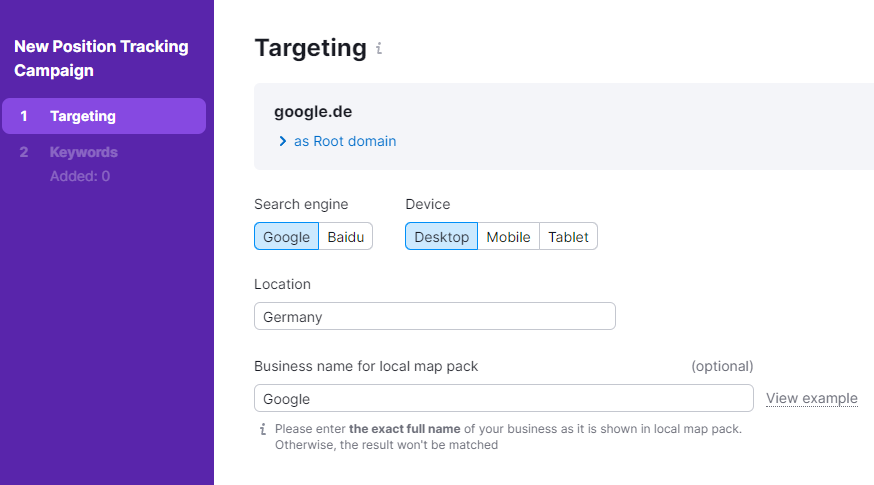
Track your progress.
Track your SEO strategy’s performance in the German-speaking markets using a tool like Semrush (shown in the image below).
Use the data to find your top content opportunities in this market and continuously update and improve your content plan.
 Screenshot from Semrush, June 2022
Efficiently Expand Into The German Market With SEO Using A Proven Process
Expanding your business into new markets can be a daunting task, but it’s also an incredibly rewarding one.
When you break through to new frontiers, you open up a world of opportunities for your business.
So, don’t be afraid to venture into German-speaking markets – with the right SEO strategy in place, you can see amazing success.
More resources:
Featured Image: Stanislaw Mikulski/Shutterstock